
Simplifying Segmentation: RFM Essentials
Part of the Easy Strategies Series for Insightful Targeting


Let’s talk about segmentation and why it’s a fundamental strategy in marketing that involves dividing a broad customer base into smaller groups with similar characteristics, needs, or behaviors. It's crucial because it allows businesses to tailor their marketing efforts more effectively, ensuring that the right messages reach the right people at the right time.
By understanding the distinct segments within their market, businesses can enhance customer engagement, improve satisfaction, and ultimately drive sales and loyalty. As we delve into RFM (Recency, Frequency, Monetary) segmentation, we'll explore how this specific approach helps businesses identify valuable customer groups.
What is RFM?
It’s stands for RFM (Recency, Frequency, Monetary) sefgmentaiton. It’s a marketing analysis tool used to identify a company's best customers by examining how recently and frequently they made purchases, and how much they spent. It's a method of categorizing customers based on their transaction history.
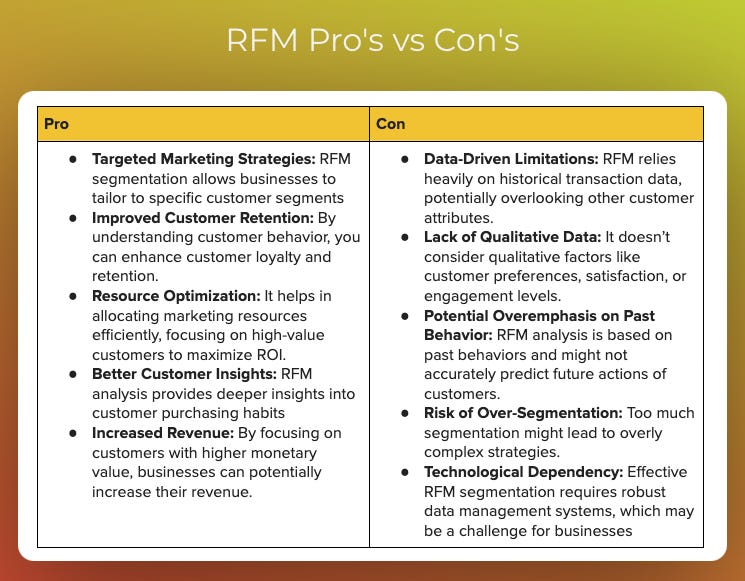
Let's check the procs vs cons:
Prerequisites
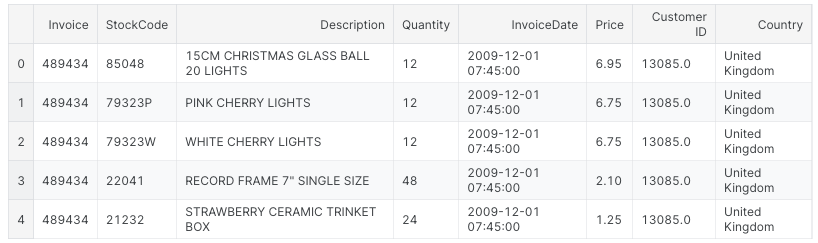
To be able to run such an analysis, it's important to have the transactional data structured in the following manner:
Customer Id (or any identifier like email, etc)
Transaction Identifier
Transaction Count
Transaction Date
Transaction Value
This structured data is crucial for developing a rule-based model to segment your customer base efficiently. Here is the data sample that would do the trick for RFM.
RFM Methods
Customer behaviors are categorized using three key factors in RFM segmentation:
Recency: This measures the days elapsed since the customer's last purchase up to the current analysis date.
Frequency: This counts how many times a customer has purchased a service during the analysis period.
Monetary Value: This calculates the total money a customer has spent on services in the analysis period.
Based on these factors, customers are given scores, with each factor contributing to their overall score. The scores are then used to assign customers to specific clusters.
Scoring example:
A customer with a score of (5,5,5) falls into the 'Loyalist' category, indicating they have recently made purchases, do so frequently, and spend a significant amount.
Similarly, a customer with scores of (1,1,1) is placed in the 'Lost' category, indicating a long time since their last purchase, infrequent buying, and lower spending.
The scoring system ranges from 1 to 5, where:
Score 1 indicates the longest duration since the last purchase, the least frequency of purchases, and the least amount spent.
Score 5 denotes the shortest time since the last purchase, the highest frequency of purchases, and the greatest amount spent.
Categorization (definitions)
This table provides a view of the different customer segments based on RFM analysis, along with remarks to understand their current engagement level and potential. This should help guide you when selecting your own RFM segmentation.
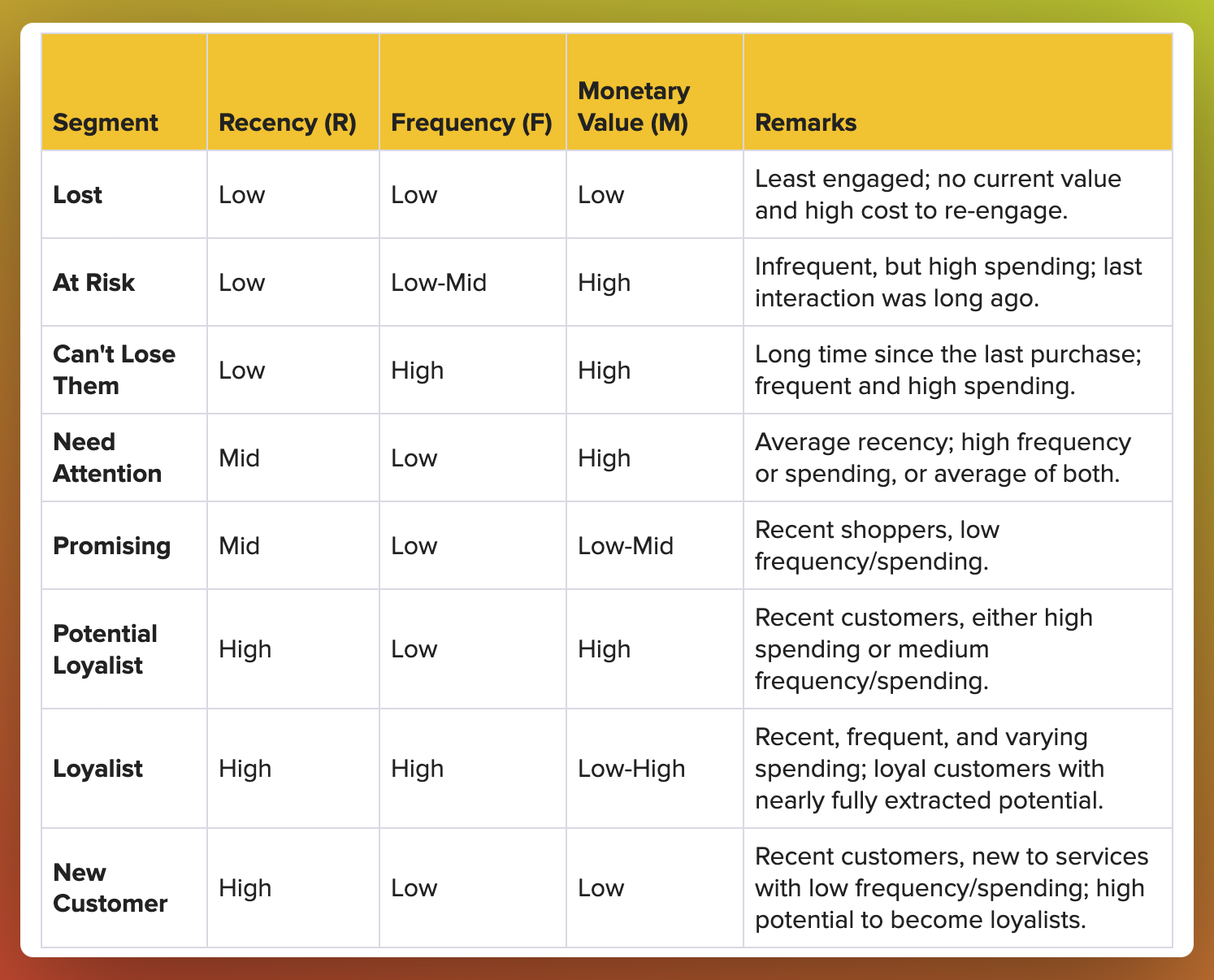
This categorization framework aids in identifying where each customer stands in their journey with your brand, allowing for tailored strategies to enhance their engagement and value.
Customer Transition States
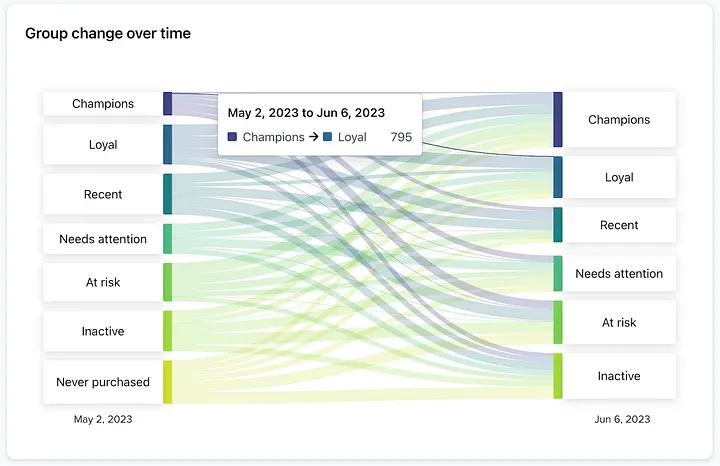
Keep in mind to track customer transition states, where customers are moving from one segment to another. This will help define the shifts across the segments and valuable insights into customer loyalty, potential churn, and overall engagement trends.
Key points on tracking customer transition states:
Identify Movement Between Segments: Tracking involves observing how customers move from one RFM segment to another over months. For example, a customer may shift from 'New Customer' to 'Potential Loyalist' as they increase their purchase frequency and spending.
Understand Churn Trends: By monitoring transitions, you can identify if customers are moving towards lower engagement segments, such as from 'Loyalist' to 'At Risk.' This shift could be an early indicator of potential churn.
Evaluate Marketing Impact: Transition tracking helps assess the effectiveness of marketing strategies. For example, if a targeted campaign is successful, you might see customers moving from 'Need Attention' to 'Can't Lose Them'.
Examples of customer transitions:
Month 1 to Month 3: A customer initially categorized as 'Promising' due to average recency and low spending may transition to 'Potential Loyalist' as they begin purchasing more frequently.
Month 4 to Month 6: A 'Loyalist' who hasn't made a purchase recently might shift to 'At Risk', indicating a need for re-engagement strategies.
Month 7 to Month 9: A customer in the 'New Customer' segment, with high recency but low frequency and spending, could either move towards 'Loyalist' or 'Lost', depending on their subsequent interactions.
Example of visualizing the transitions:
Few parting words
RFM segmentation stands out as a key tool for companies with limited technical resources and time. It offers more than a snapshot of customer engagement; it guides long-term strategy. By monitoring customer transitions between segments, we gain insights into behavior patterns, forecast future changes, and customize our marketing strategies. Essentially, RFM is about building and growing with our customers.
In the next series, we will cover other techniques for customer segmentation and lifecycle stages based on individual behavioral data and natural transactional patterns.
Hey, loving these insights? Why not spread the word to a buddy? And hey, if you're not already riding this newsletter wave with us, come on and subscribe!
Cheers,
Vuk