
Navigating the Complexities of Your MarTech Stack
What does MarTech space entail. Lesson learned from experiences in Uber/Careem and Delivery Hero

TL;DR of “Navigating the Complexities of Your MarTech Stack”
MarTech, or marketing technology, has transformed from automating simple tasks to becoming a crucial link between diverse business functions. While the potential is immense, navigating its intricacies can be daunting, with challenges ranging from lack of expertise to integration mishaps. The guide offers insights on understanding your stack, pitfalls to avoid, strategies for optimization, and the benefits of seeking expert advice.
A Brief History of MarTech
The evolution of marketing technology, or “martech,” traces back to the advent of the internet, revolutionizing how businesses approach to marketing. Initially, the focus was on automating manual tasks to enhance efficiency—for instance, scheduling emails to customers. But today that scope expanded with the same aim in mind.
But what does martech represent in today’s landscape? It serves as a vital link between product development, growth strategies, engineering, and traditional marketing. Martech orchestrates an integration of methodologies from these diverse areas, aiming to construct an optimized arsenal of marketing tools. It requires a deep comprehension of marketing’s business challenges, followed by the architectural design of a collaborative ecosystem where first-party and third-party solutions converge to pursue unified objectives. Moreover, it demands establishing protocols encompassing personnel and vendor management.
Yet, navigating the martech ecosystem is often fraught with hurdles. One predominant challenge is the scarcity of dedicated roles and profound expertise within the realm of marketing management. Further complications arise from integration mishaps, inconsistent tool utilization, and data silos, all of which hamper the fluidity of marketing operations.
In essence, the meticulous configuration and optimization of a martech stack are fundamental to the efficacy of marketing endeavors. This comprehensive guide is designed to steer professionals through the worlds of martech, demystifying its complexities, and laying a pathway towards a more streamlined and effective marketing machinery.
Understanding Your MarTech Stack
Delving into the realm of martech stacks requires understanding their composition and their role within various organizational structures. The configuration of tools and the team’s specialization can significantly differ between a startup and a seasoned enterprise. For instance, during the transformational phase of Careem’s [Uber] into a SuperApp, we realized that no specific Product Management team was responsible for martech. This gap propelled us to take charge, developing solutions within the Growth function to drive growth.
At first, we learned through trial and error. Our mistakes helped us figure out the skills we needed, how to budget wisely, and how to plan effectively for success.
This leads us to design a technological framework to enhance the customer experience by bolstering relevance and efficiency, all while decreasing time and expenses. The initial step often involves an assessment of available solutions, followed by decisions to develop or procure additional tools to meet specific goals.
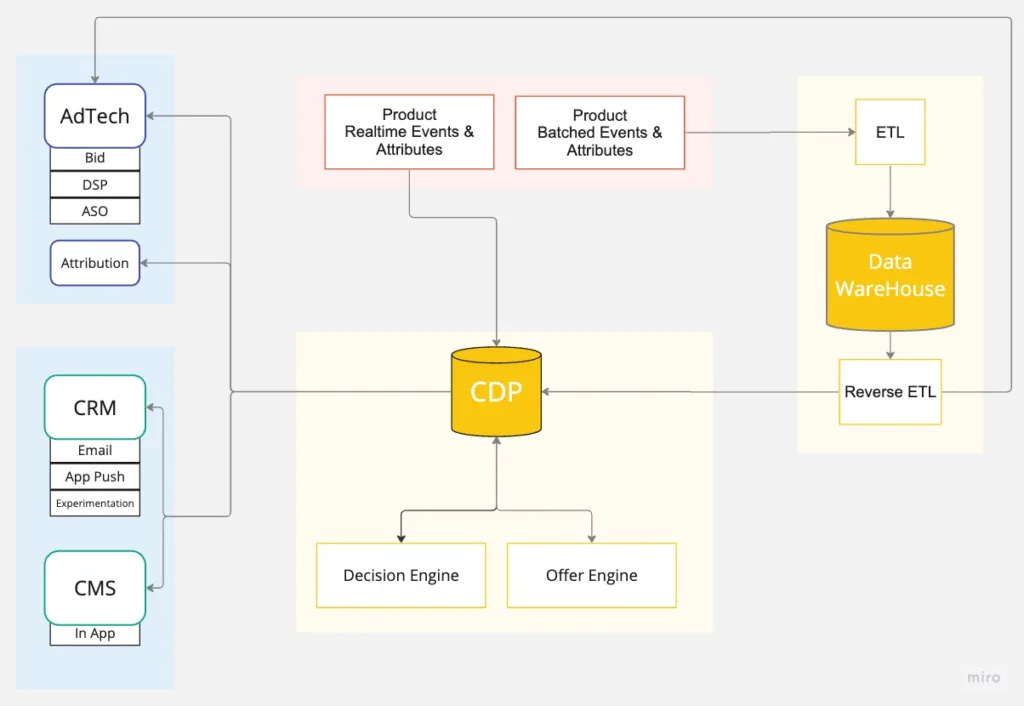
A typical stack might include a CRM system, often a third-party integration, equipped with omnichannel communication features like email, push notifications, in-app messaging, SMS, and landing pages, coupled with segmentation and analytical tools. Then there are Content Management Systems (CMS) – particularly for app-centric products, these are custom-built solutions facilitating the strategic display of products and ads, enhanced with personalization and segmentation features. Additionally, unified data repositories, whether they’re Customer Data Platforms (CDPs) or custom-built integrations, play a critical role in consolidating customer data, streamlining identity management, and enhancing targeting through calculated attributes, such as predictive modeling or lifecycle stages.
Certain tech stack elements, based on our journey, were developed in-house to heighten relevance, including predictive models and AI-driven segmentation and personalization tools.
Ultimately, each element of a MarTech stack contributes a distinct value, and its power is amplified when these components are seamlessly integrated, functioning as a cohesive ecosystem. This synergy not only provides a holistic view of the customer journey but also simplifies the amplification of marketing initiatives, deepens the personalization of customer interactions, and ensures campaign efficiency. Paramount to this is the alignment of your martech stack with overarching business objectives and marketing strategies. It requires precise tracking and performance measurement, and ultimately measurement of your MarTech’s return on investment.
Common Pitfalls in MarTech Stack Management
Navigating the challenges inherent in managing a martech stack can be daunting, particularly when organizations encounter obstacles such as the absence of specialized teams or a lack of expertise. These deficiencies can spiral into more complex problems like redundant tools, ineffective integrations, neglected data quality, and a reluctance to embrace emerging technologies. I recall a scenario during our transition from multiple apps to a unified platform where the martech stack adaptation was an afterthought. This oversight resulted in numerous glitches, including lost customer information, repetitive tracking events, and unsynchronized solutions reaching out to clients. Such missteps inevitably result in squandered budgets, subpar customer experiences, diminished data insights, and a drop in team efficiency.
So, how can companies preempt these errors? It starts with gaining a precise understanding of your objectives and recognizing how marketing technology could be instrumental in achieving them. Such insights make it easier to determine where resources should be channeled, identifying the tools to purchase, and the solutions to develop in-house. Prioritize constructing your stack with an eye on your immediate needs, ensuring it’s agile enough to expand in response to future demands. For example, even without advanced attribution models in place, you can begin by monitoring key data points throughout the customer journey, such as user behaviors and interactions within your website or app. This foundational data is crucial, as it can later empower more complex analysis like Multi-Touch Attribution or Media Mix Modeling, enhancing your resource allocation strategies.
Furthermore, assigning a martech champion is crucial. This individual or team will take charge of the stack, overseeing the intricate aspects of tool integration, data integrity, and technological adaptability. Alternatively, enlisting a consultant or a subject-matter expert can provide the foundational support needed, guiding the initial setup of your roadmap and martech stack configuration. This strategic approach not only circumvents common pitfalls but also places your business on a trajectory for sustainable success.
Leveraging Full Potential: Optimization Strategies for Your MarTech Stack
To unlock the full potential of your MarTech stack, it’s crucial to align it with your core business objectives and alleviate any existing pain points for your marketing and growth teams. This process involves understanding your system’s current capabilities and identifying gaps that might be hindering the achievement of your goals.
“For many larger organizations, the key challenge lies in simplifying and streamlining their tech stack.”
For many larger organizations, the key challenge lies in simplifying and streamlining their tech stack. It’s common to encounter multiple tools that have overlapping use cases and functionalities, leading to inflated budgets, inefficiencies, and decision-making paralysis. To illustrate how we assess a tool’s fit and functionality within a business, consider this framework:

Utilizing this framework, we can pinpoint tools that may be redundant or misaligned with company objectives. For example, let’s say you have a CRM system that manages omnichannel communications. Yet, there’s a separate, legacy tool for sending SMS to a specific country because it’s cost-effective. Simultaneously, another email solution, cheaper but lacking in tracking capabilities, operates in isolation—even though your CRM package includes unused email services. By conducting a thorough cost-value analysis, it becomes evident that while the SMS tool adds value, the email solution does not. A logical step would be to fully harness the CRM’s capabilities and integrate a service solely for cost-effective SMS delivery to the target country, thus eliminating the standalone email tool.
Furthermore, when evaluating your stack, it’s essential to factor in your engineering resources. Using our example, if the CRM system can trigger API endpoints via webhooks to a third-party SMS provider, then it could manage the sending process, eliminating the need for additional technical resources or integrations.
Seeking Professional Guidance: When to Hire or Consult MarTech Experts
Recognizing when it’s time to seek professional guidance for your MarTech stack management is crucial. A clear sign is the absence of clear ownership of the MarTech stack, typically manifested through ongoing technical problems, underwhelming marketing outcomes, or an inordinate amount of effort expended on straightforward automation tasks. Additionally, consistent delays or bottlenecks, particularly due to single failure points like a shortage of dedicated support from data or engineering teams, signal the need for expert intervention. Recognizing when it’s time to seek professional guidance for your MarTech stack management is crucial.
A clear sign is the absence of clear ownership of the MarTech stack, typically manifested through ongoing technical problems, underwhelming marketing outcomes, or an inordinate amount of effort expended on straightforward automation tasks. Additionally, consistent delays or bottlenecks, particularly due to single failure points like a shortage of dedicated support from data or engineering teams, signal the need for expert intervention.
Key Benefits of Consulting a MarTech Expert
Bringing in a specialist can significantly transform your MarTech journey. They assist in crafting a specialized architecture and the strategy to actualize it, offering in-depth insights and solutions. This approach includes decreasing reliance on engineering teams, which can often be overburdened with cross-departmental requests. Moreover, experts provide informed strategies for evaluating tools, aiding your business in making educated decisions on whether to purchase, develop in-house, or combine both approaches for optimal functionality.
Selecting the Right MarTech Partner
When it comes to choosing a MarTech partner, you need more than just a seasoned professional. You’re looking for a collaborator who understands your sector, business model, and strategic goals. They should be able to interpret your current struggles and future aspirations, providing tailored solutions that align with your business objectives.
Key Takeaways:
Evolution of MarTech: Transitioned from task automation to orchestrating product development, growth strategies, and engineering.
MarTech Landscape: Essential for marketing success, but often fraught with challenges like data silos and expertise scarcity.
Tool Integration: Seamlessly integrating diverse tools amplifies marketing initiatives and deepens customer insights.
Common Challenges: The absence of specialized teams, redundant tools, and reluctance to adopt emerging technologies can hinder success.
Importance of Expertise: Consulting with experts can provide strategic enhancement, insights, and foresight into MarTech optimization.
In essence, assigning or consulting with a MarTech expert is less about patching holes in your current system and more about strategic enhancement and foresight. It’s an investment in your organization’s efficiency, capability, and future growth, ensuring your technology stack doesn’t just meet the demands of today but is agile enough to adapt to tomorrow’s challenges.